Showing posts with label rules of writing. Show all posts

Sunday, February 22, 2015

BIN TO BESTSELLERS: THE IMPORTANCE OF OTHER PEOPLE IN YOUR WRITING LIFE

Making money writing is the hardest job on planet earth, however, there are people who do it effectively and make a living out of it. Being not one of them is not your problem, but aspiring not to be one is.

Is finding a publisher the best option for you as a writer? Richard Bach once mentioned in an interview; it’s not a publisher a writer searches for, but an editor. This relationship is one that should last for a lifetime. An editor understands where the music of words has to be slowed down or where it must run faster. But to get one worthy enough, you must do a lifetime’s waiting.

As a beginner in freelancing and in professional writing, how do you get an editor whose service can be worthwhile? Beginners are always stuck with the same problem; lack of funds. This in turn hampers your look out for an editor. Good editors are sale items with relatively high price money. There are many writers’ communities that offer editing services. Even some literary agencies offer you with editing services. However, if you are a first timer and one without enough weight in your bank account, hiring an editor for your book or manuscript will not be, normally, easy.

The best way to tackle this situation is to find reliable and easy options for editors. One need not go much farther for this end. Just look around and you will find yourself to be blessed with many minds, gifted with the one serum of eternal life—love—around you, ready to help reading your manuscript.

Showing your manuscript to your friends and family or girl friend would be a better option. In such a case, the money spent would be much close to null on editing services. The best editors are those who actually care for our work. You must be open to their criticisms; however, in harsh criticisms you can always rely on their lack of professional experience as the hideout from humiliation.

Stephen King, when he wrote his first novel, Carrie, did not think it would make up to the publishing standards and threw it into the bin. But his wife Tabitha King accidentally discovered the manuscript and read it. Thinking that it would be something worth of a quality, she put it back on the table and later helped King to rework on it. The novel went to become a best seller of its times and was made into a successful Hollywood movie.

This is one real life example from the life of America’s most celebrated and enthusiastic writer, Stephen King. This could be yours too. A relationship not just helps an individual to maintain one’s emotional health but the creative output as well. Now wait your sweet heart to tell you where to put the period.
ABOUT THE AUTHOR
Anu Lal is the author of Wall of Colors and Other Stories. His latest book is Clenched Hands, Bloody Nails.  You can catch up with him in Facebook too.  

Sunday, January 18, 2015

PSYCHIC REALITIES: Writers and their Minds

Oh my God! I desperately wanted to finish that story. Look! I just abandoned it. I had been working on it for the past one month. It’d been six weeks since I hadn’t touched it. Would I be able to resume it? How could I do justice to the story, now, after such a long time of discontinuation? I did have some notes made from the times, while I worked on the stuff. I do not think those notes are of any help, anymore, though. 

It is clear to me how vague the classification of writers would be if I categorized them based on such feelings as above. A writer, at almost all stages of his or her growth feels this way. Most of those super-successful writers may not experience it the same way, because they have the ability to pursue writing without bothering much about another day-job, but apparently have other issues that affect them the same way.

If writing gives a person immense pleasure or joy, and the person is forced to work in a bakery in order to make a living, the resulting conflict could damage the mental equilibrium of that person. Those person(s) who have no aptitude for working in a bakery, when forced to compromise their psychological ecosystem with the sophistication of an altogether different system of things, creative writing suffers. This is when one feels; “Oh my God! I desperately wanted to finish that story. Look! I have abandoned it.”

The fear for being not able to do justice to one’s work of a lifetime deserves wise handling. If not, it will consume the writer, wholly. The totality of all fears has their common grounding in the unknown. In the case of the above-mentioned writer (let us call him Paul), the unknown part is the quality of his work. Paul does not know and fears this fact: how would it all turn out to be. How could I do justice to the story now, after such a long time of discontinuation?

In order to undo the fear of the unknown, the simplest method can be the Jungian concept of assimilation of psychic realities. Carl Gustav Jung (1875–1961) was a German psychoanalyst, whose groundbreaking theories on human mind, guided the world into a modern-renaissance. He argues about a specific course of action through which a human being can bring out the contents of his unconscious and experience it in the conscious level in order to alleviate the pressure from the unconscious side.

This same method is useful in undoing the fear for the unknown in Paul’s case. If Paul is uncertain of the results his work could bring him after a considerable gap in the process of writing, he should first, look at the results. There is only one way he can get the result—by completing the work. Paul just needs some gut feeling to cross the initial fear.  
Image Courtesy: meetville.com

If one is stuck with the fear of how the work would turn out to be, the possibility of writing a book or a story is obliterated entirely. It is up to you to take that step courageously. Your work deserves to be born, simply because you have such strong feeling for it. Let your fears not obligate the stopping of your creative work.


If you liked this article, you might like my book too. Take a look.

You can catch up with him in Facebook too.      


Tuesday, July 23, 2013

Great writers on 10 rules for writing fiction

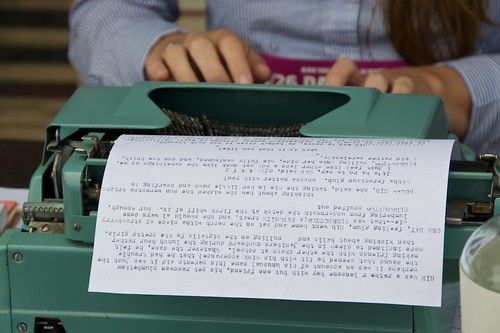
Photo: “8/26 Day Write-a-thon for 826 Valencia” by Flickr user Steve Rhodes
under Creative Commons 2.0 License
Back in February 2010, the Guardian asked a number of well-established writers to offer their 10 Rules of Writing in response to Elmore Leonard’s own. Those who responded include: Margaret Atwood, Roddy Doyle, Helen Dunmore, Richard Ford, Jonathan Franzen, Esther Freud, PD James, Michael Moorcock, Helen Simpson, Zadie Smith, Colm Tóibín, Sarah Waters and Elmore Leonard himself.

The results, which can be read make interesting and entertaining reading.

Here are some of my favourite extracts:

Elmore Leonard:

Never open a book with weather… The reader is apt to leaf ahead look­ing for people.

Avoid prologues: they can be ­annoying, especially a prologue ­following an introduction…

Never use a verb other than "said" to carry dialogue.

Never use an adverb to modify the verb "said" ... he admonished gravely. To use an adverb this way (or almost any way) is a mortal sin. 

My most important rule: if it sounds like writing, I rewrite it.

Zadie Smith:

Try to read your own work as a stranger would read it, or even better, as an enemy would.

There is no "writer's lifestyle". All that matters is what you leave on the page.

Tell the truth through whichever veil comes to hand – but tell it. 


Esther Freud:

Trust your reader. Not everything needs to be explained. If you really know something, and breathe life into it, they'll know it too.

Cut out the metaphors and similes. In my first book I promised myself I wouldn't use any and I slipped up ­during a sunset in chapter 11. I still blush when I come across it.

Hilary Mantel:

Are you serious about this? Then get an accountant.

Michael Moorcock:

For a good melodrama study the famous "Lester Dent master plot formula" which you can find online. It was written to show how to write a short story for the pulps, but can be adapted successfully for most stories of any length or genre.

(Wikipedia gives this as Michael Moorcock’s summary of the Lester Dent master plot formula: Split your six-thousand-word story up into four fifteen hundred word parts. Part one, hit your hero with a heap of trouble. Part two, double it. Part three, put him in so much trouble there's no way he could ever possibly get out of it...All your main characters have to be in the first third. All your main themes and everything else has to be established in the first third, developed in the second third, and resolved in the last third.) 

If possible have something going on while you have your characters delivering exposition or philosophising. This helps retain dramatic tension.

Ignore all proferred rules and create your own, suitable for what you want to say.

There is much more to savour in these lists. I recommend checking out the full article. Enjoy!


Seb Kirby

Seb Kirby is the author of the James Blake thriller series (Take No More, Regret No More and the soon-to-be-released Forgive No More) and the Raymond Bridges sci-fi thriller series (Double Bind). 

He says: "I was raised with books – my grandfather ran a mobile library in Birmingham and my parents inherited a random selection of the books. They weren't much interested in them; they were piled up in a box room, gathering dust. I would disappear in there and resurrect much used classics – Zane Gray's Riders of the Purple Sage, HG Wells' The Invisible Man, Charles Dickens' A Tale of Two Cities and more obscure stuff that I don't now recall. I was hooked. I've been an avid reader ever since."