Showing posts with label Germnay. Show all posts

Monday, April 9, 2012

Happy Easter Eggs!

On this second day of Easter (most of Europe has two holidays!) allow me to reminisce.
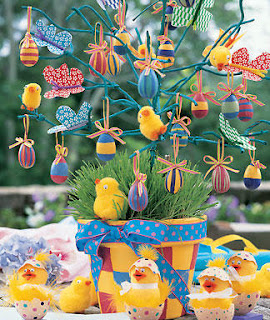
Yesterday it was 22 years that we started our adventure in Ireland. We developed a tradition in our new home that we had brought with us from Germany.
Our neighbors’ kids were flummoxed that there was an Easter Bunny to visit German children that brought them sweets and colored eggs—even to those living abroad. In our first year we could see our new neighbors peep through their front windows. It wasn’t customary at the time to have an egg hunt in Ireland. In the following years we invited them to join us but often Mass took precedence so that they couldn't make it.Much to their chagrin.
Since the weather was often dreadful and our offspring couldn’t be relied on always finding what had been left for them in obscure places, we came up with a clever strategy. On Easter Sunday, Mac would take us through the gardens pretending to look for hidden eggs. He had all the goodies in his big overcoat and dispensed them furtively as he went along. Amy and Patrick hung back with me, thoroughly inspecting each shrub and little tree for possible hiding places. The garden was big enough for him to forge ahead without them noticing. This maneuver had a double benefit. Neither did the chocolates or colored and decorated eggs get soaked nor did we find surprises later in the year when some gardening was going on in that area. We also continued  the German tradition of decorating the house with fresh spring twigs and blossom, ornate  with decorated eggs, bunnies or butterflies.
The Ex Farmer's Wife

Sunday, March 4, 2012

Green Germany vs. The Green Isles: a Culture Clash

When we made the move to Ireland, organic farming, self-sufficiency and the whole shebang, we had years of green living and environmentally consciousness under our belts. Germany of the 80s had taken great strides in raising the public awareness. The Green Party was well established. As a German, I had been brought up with the motto “Waste not--want not”, that my grandparent’s. i.e., the war generation had drummed it in to us. It was natural to us to switch off any light upon leaving a room, or other unused gadgets, as it was to hang out the wash if the weather looked promising to save on electricity. In order to save on water and avoid surface pollution, German law forbids washing your car in the street. You must go to a car wash instead. The petrol crisis and the warnings of the club of Rome in the mid 70s had contributed to people saving gas whenever possible, downsizing cars, putting catalytic convertors in; cars were made fuel efficient. A debate was raging for years whether diesel or petrol was better for the environment. Another question was foremost on environmentalists’ minds: Does one save petrol by switching off the engine at a railroad crossing while waiting? Or at a red traffic light? In addition, being a bit of an activist –some said busybody - I would get out of my car in such a situation and ask the drivers before and behind me, “Does your engine have problems in starting, or don’t you want to save the environment?” A speed limit was introduced in busy parts of Germany. The sky was no longer the limit as urban myth abroad about the Autobahn still claims.
A levy of 10 Pfenninge on plastic bags had been introduced early on in the 80s when grocery shopping. So people made the switch and got accustomed to taking their own bags or baskets. We used rainwater for watering plants, off switched the tap while brushing our teeth and on again for rinsing. Water saving devices were installed into toilets, one for the small and one for the full flush. We avoided chemical cleaners around the house and substituted them with baking soda and vinegar.The use of aluminum foil and saran wrap as well as paper kitchen towels were reduced to a minimum. Freezers were defrosted regularly in order to reduce electricity. And then, after we had left for Ireland in 1990, recycling was taking to an all new level. Until then, you kept paper and glass separate for recycling anyway, in addition, a bio bin was introduced for scraps from the kitchen, and an extra bin for plastic or what is called “rest trash”. In some cities, households have 4 different trash cans. If you dare to mix the ingredients, maybe even by mistake, the bin men won’t pick it up.
Detergents were used ever so sparingly. Water softeners were the work of the devil since they hypertrophied rivers and lakes which results in unwanted algae growth. There is no need for them if you hang your wash in the breeze, and definitely not if using a dryer.
When building our new house in Germany, it was built according to environmental standards with eco-friendly materials, in particular paints. In the renovating process of the Irish farm, Mac took gallons of Livos paint (eco!) on board in his hand luggage while I navigated 2 toddlers and their nappy bags in a stroller. Patrick, my second born, wasn’t exposed to disposable nappies –no, we had linen diapers and self-knitted panties made out of home spun untreated sheep wool. I didn’t spin though, only knitted …and then kept washing. They made the naturally big baby enormous around the midriff!
At some stage I had taken to making my own soaps and shampoos but it never turned out well enough for satisfactory results.
Being well trained in so many different areas, Ireland came as culture shock. The so called Green Isle was anything but “green”. Hedgerows were littered with plastic bags. My neighbor kept burning their rubbish, even attempted at setting metal cans on fire, exchanged their oil in the yard and let it drip down on the ground. I was the only one in the local store who brought a basket. Everybody else, even for buying just one bag of chips, got a plastic bag to wrap his purchase. In answer to the shop owner’s question why I bothered since there were plastic bags,I told her about the German levy on bags. She frowned and said condescendingly, “That wouldn’t go down well in this country”. It took about 15 more years until Ireland had to face the music, too, as part of EU regulations. They are paying for plastic bags too now.
There was practically no awareness as to what was harmful to the environment, organic and eco products were not available. Clothes were way cheaper than in Germany but often made of poor quality, i.e. synthetics and not degradable. None of towns around Lough Dergh had a single water treatment plant until 1995. All household waste and sewerage plus farm effluents went untreated straight into the lake. So did the waste from numerous boats cruising on the lake, a tourist gem, and the River Shannon.
Encountering this challenge in my newly adopted country made me bite my teeth on an ongoing basis. I was fit to be tied facing this sea of backwardness and having the ambition to change things for the better. I tried for many years. It’s hard work to convert a whole country.
Now here in the USA, I’m facing an even bigger challenge. Not just because of the size of the country, but because the irrefutable knowledge is there and widely available. The inertia that surrounds me seems to be unsurpassed, however. Apologies to states like WA , OR and CA where things are different.
The Ex Farmer's Wife
Twitter:@Hernibs