Showing posts with label answers. Show all posts

Thursday, December 18, 2014

MEASURE OF WRITING: Inborn Talent?

Image Courtesy: Google
In this glorious chaos of what to listen to, and what not to, I would like to invite your attention to the fantastic idea called “good writing.”

I am aware that one of the areas, a person coming to WGT might be looking for, is insights from personal experiences of other authors. Due to that very purpose, I would like to share an experience of mine here, in this ‘internet coffee house’ of a blog, as author and editor Scott Bury remarks.

Good writing is an imperative every writer pets with in one’s consciousness. Consequently, there are several myths circling this idea.                
 
Image Courtesy: blogs.denverpost.com
Stephen King once remarked that creative writing could never be taught in schools. He was telling the truth about ‘good writing’ too. Perhaps the biggest impediment in being a creative writer (and a good one in that) is the only boon capable of propagating one in the direction of a successful writing career—Inborn talent. But what about you, a person blessed with the gift of weaving extraordinary tales out of ordinary events in life? Are you born with “Inborn talent”?

What might be the secret of being a good writer, of selling more stories than the number of tickets for the next Hollywood blockbuster; of being the most loved and respected man of letters? The surest way to success in this dimension is perseverance.

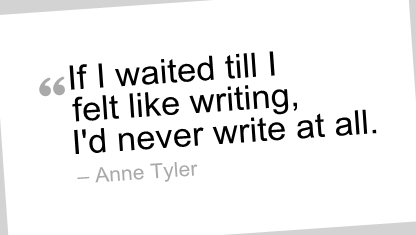
As a writer, one might come across many external obstacles; obstacles from our day-job, obstacle in the name of family, etc. These obstacles, sometimes with our knowing and sometimes unknowing, sucks out what could be described as the surest key to becoming a good writer. I would never suggest one must wait for the right moment to pen a story or to edit a previously written manuscript. The right time for a writer is NOW.

Remember, you are here because you love reading about writing and want to learn a few techniques on improvising your writing. You have listened to your call, by coming here. You have that inner radio inside of you that could tune into the cosmic energy that is the Source of all Creation.  

If you arrived here with a desire to learn, I must tell you that you have the necessary ingredients in your DNA to make it big as an author. You are in alignment with that dream that you have nurtured throughout your life, of sitting on a table, signing books at one end of an incredibly long line of people, simply because you are reading this article.

This is not a self-help forum. Still, I would advice a new author to take perseverance as your measure when the path in front of you is not visible, when you meet a dead-end. For example, think about Dr. Viktor E. Frankl’s experiences in the concentration camp of Auschwitz. Had he not been persevering, his future and the future of psychoanalysis itself would have been something else. In such a situation, perseverance means you trust your abilities to risk every other madness around you. It results from trusting oneself. Dr. Viktor E. Frankl shares his experiences in the book titled Mans’ Search for Meaning.  
 
Image Courtesy: Google
The craft of good writing also stems from trusting oneself. However, I would also suggest you should not limit your trust upon the blind faith that ‘whatever you do would be good’; or daydreams about long lines of people waiting for your autograph. Although, it sounds almost naïve, I must say that one must act in order to bring success into the world of reality. This, I consider, is a valid thought for any aspiring writer. Most aspiring writers never make it to the successful line of authors. The reason for that is simple: most aspiring writers only aspire. Their aspirations are not strong enough to manifest themselves into material reality.

The next best thing to do in order to bring in your ‘good writing’ is to trust your own intuitions and write steadily. By carrying the purpose, and following the discipline required to finish specific writing projects, you are sure to succeed. In writing-life, failure has only one meaning—stopping a work. This means, essentially that if you don’t stop, you never fail.  

About The Author:
Anu Lal is the author of Wall of Colours and Other Stories, Book-1 in the Hope, Vengeance, and History Trilogy. He resides in India. His second book You Should Know How I Feel has been a bestseller in Amazon India.
Author Page: Here

Twitter: @Anulalindia

Friday, December 12, 2014

AFTERWORD TO BEGINNING

Image Courtesy: Goodreads.com
In his admirable attempt to bring submissions and participation one final time into Writers Get Together, author and Editor Scott Bury wrote an article the previous year. The article was published in November 17 and is titled “Not farewell, but au revoir”. This article beautifully narrates the grand message that Writers Get Together (WGT) stands for. He writes that WGT is “a blog that serves the function in the digital world of the old-fashioned coffee house, where writers can share new work, experiment with new ideas and get feedback from colleagues.” What better definition could serve the purpose!

Shortly after the appearance of this article, WGT was shut down. Although, WGT was “up for grabs” for anyone who could make use of its wide possibilities, as its owner Siggy Buckley reluctantly suggests in her post that followed Scott Bury’s, no one else discovered Scott Bury’s vision. Perhaps, this is one of the drawbacks of the internet era. There is too much noise out there that the possibility of listening to a conversation has become minimal.
 
Image Courtesy: azevedosreviews.com
In my personal journey as an author, I have realized that writing a book is definitely not a subjective affair. It has to involve people. From cover designing to editing, from proof reading to printing and from penning the outline to selling or buying, a writer is never alone. Should never be alone.

In my research, I discovered that most successful writers are those who have successfully established their connections with the reading public. This they achieved, in the past era, through print magazines and articles or serialized version of stories in newspapers. Charles Dickens from nineteenth century is a good example of this style of writing. It is part of the profile building procedure for a writer. The more people who love your style of writing, the more will be the number of your books sold. In reality, this is true. I have experienced personal success in this same manner. The success with my second book was greater than that with my first book. My second book, You Should Know How I Feel was noticed by a greater number of readers and became a bestseller in Amazon India.

In our time, the role of print magazines and newspapers are effectively supplemented by blogs. Using blogs writers can let the world know about their presence in the literary scene. Write a guest post, or a regular column. You can make your presence felt.

Also please remember, it is not always about making more money or marketing your book. By writing about your writing life, books, or any other affair, you are essentially being connected with another individual, sharing your life with that person, and receiving their feedbacks and blessings. Scott Bury’s coffee house analogy is in perfect harmony with what a writer wants in the current era to perform at the best of one’s abilities. It will give an opportunity for working in teams as well as nourishing one’s craft with newer possibilities and suggestions by fellow writers working from different parts of the world, an idea Mr. Dickens would have died for, in his times.
 
Image Courtesy: Google
I am a writer from India. If you are reading this article from the US or Ireland, or Japan, we must realize one thing immediately, without fail—this could be our best chance of bringing out the best in us. It never was like this before.

The coffee houses in London during the 19th century had writers from England or nearby European countries. If you sit in a room in New York, the US, right now and discuss your work with a writing group, you are essentially communicating with a few Americans or people who experience similar cultural, social, and political environments. In other words, if it’s snowing outside, all those writers in a small writers’ group in the US will have an unbiased say about the weather of the day. There is monotony, a complete lack of diversity. On the other hand, be a member of a writers’ blog group and you will have a person from Rajasthan, India or Texas, USA communicating with you about their individual experiences, separated spatially but united intellectually. That’s what diversity is all about. It gives great meaning to group work. Great writing is always a product of living a meaning-centered life. 

ABOUT THE AUTHOR:
Anu Lal is a bestselling author, book reviewer, and blogger. His recent book, You Should Know How I Feel... has been a bestseller Contemporary Romance in Amazon e books, and paperback. He is the first Indian author to write a trilogy in short story collections in English: 'Hope, Vengeance and History' trilogy. His upcoming book is the second one in this trilogy.  
His works are: Wall of Colours and Other Stories; You Should Know How I Feel...; Unclassified Intelligence; Prabuddha: The Clear-sighted  
Visit his blog: The Indian Commentator
Visit his author page HERE

Thursday, March 15, 2012

Letter from an Agnostic

Usually I have more questions than answers. Maybe that is part of the reason that I lean toward being an agnostic.
I have had debates with atheists about the definition of agnostic so I know that people define that word in different ways. I know many atheists think the evidence strongly leads to the belief that there is no God.
Part of my agnosticism entails being flexible with the definition of god. I think that many times people are intentionally vague about god. They don't have and can't offer a definition. Why would anyone want to interrogate someone about his definition when it might lead to animosity? Why not let it be vague? Why not interpret the word god within the context of his sentence? Sometimes people may mean inspiration, placebo effect of hope, the web that holds society together, the strength of the camaraderie of the group, the awesomeness of mother nature, or some vague delusion that helps them make it through some dark period of life.
I might answer my own question in a couple of different ways:
1. They might know something that I don't know
2. I should not let people hang on to stupid beliefs
3. I love the good debate
I think those three reasons are perfectly acceptable reasons for asking someone for her definition of god after she uses the word in a sentence. I, however,still plan to resist the temptation. I do not think the following is a good reason for asking someone to define what she means by god: Everyone needs to agree on the definitions of all words before a conversation can be meaningful. Again I would like to emphasize that I think that few (if any) can define the word god satisfactorily. I feel it is better to just use a definition that makes sense to me when I hear the word god used in a sentence. Interrogating someone about his definition of god might lead to animosity. As I grow older, I want to learn to communicate in such a way that animosity isn't created during the dialogue.
Sometimes I will interpret the meaning to be inspiration whereas another time I might interpret the meaning to be the placebo effect of hope. Perhaps I might say "would you mind if I use the word inspiration instead of god when I interpret what you are trying to tell me since I am an agnostic?" If the context of the sentence calls for another interpretation then I might substitute something more appropriate for inspiration. One of the uses of God that completely baffles me is when someone tells me she bases her morals on God. That seems a dangerous statement. Whenever anyone uses the term god in an attempt to control or condemn other people then the wording has gone beyond the benign. It has become dangerous although I still believe that a skilled
communicator can discuss morals without debating the definition of god. If the person means that god speaks directly to him then I would assume he means the voice in his head. We all have that inner voice and we have to discern which ideas are good and which are not so good.
If people mean that god speaks to them through a holy book or another person, then I guess I would have two follow up questions:
1. Do you follow the advice even if it makes no sense?
2. Could the person (giving you advice) be wrong?
I am reading a book called Ethics: Inventing Right and Wrong by J. Mackie. It has me thinking that the discussion about morals, values, and/or ethics is a serious one with serious consequences to our society. I hope that free thinkers will join in that discussion without getting lost in the god debate. It isn't about god. As I said in the beginning, I believe that most people use the term god in a very vague way. If you get stuck in
debating god's existence, then you may never move forward to the really important stuff.
Susan Ert-Ker
http://www.meetup.com/philosophyclub/messages/boards/