Showing posts with label Shorts. Show all posts

Monday, September 9, 2013

Poet Shmoet

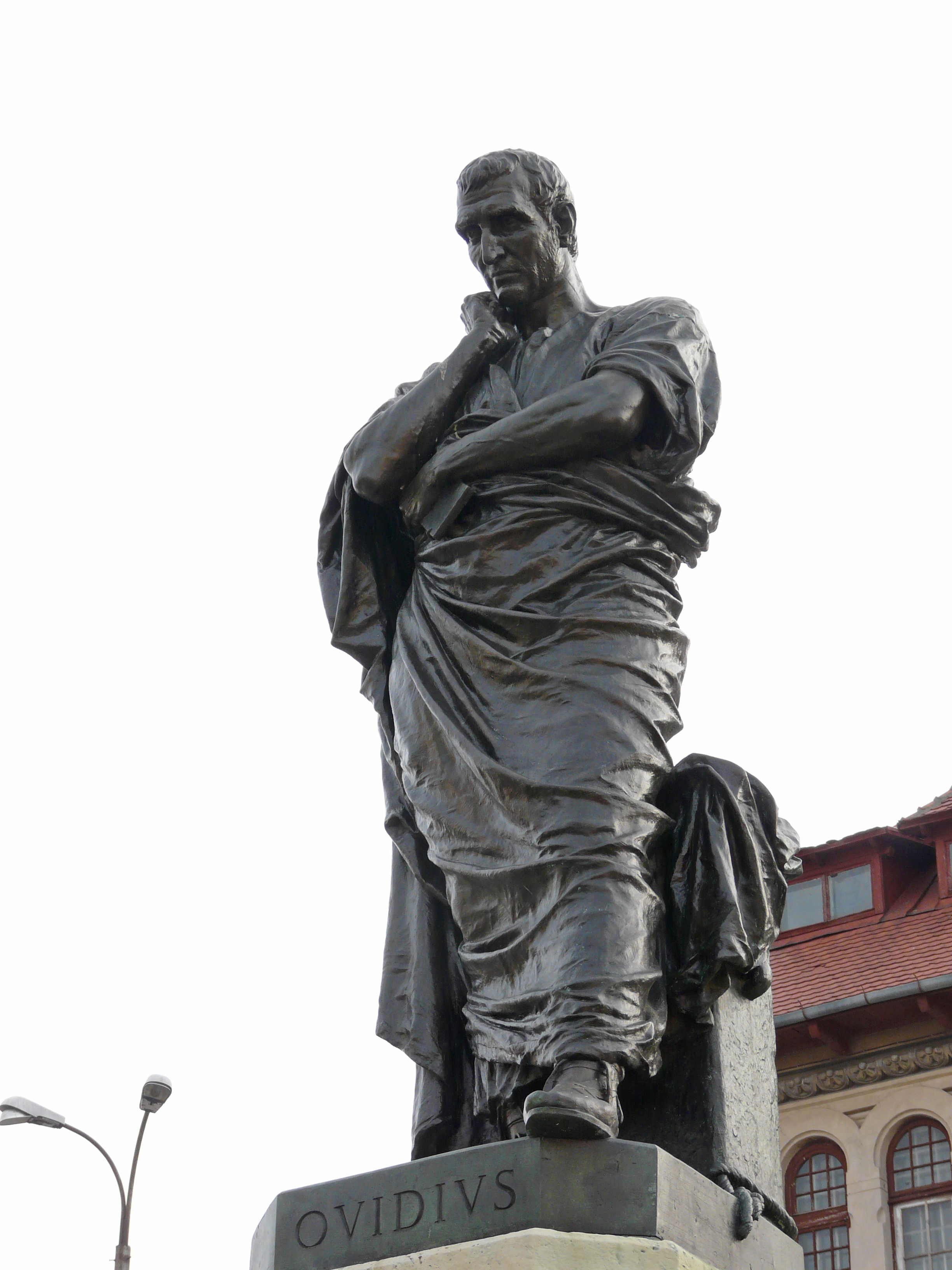
Statue of Roman poet Ovid in Constanta. Image from WikiCommons.


By Sal Buttaci  

I have never felt comfortable referring to myself as a poet. Instead, I tell folks I write poems. To me, the designation “poet” is something I have always assigned to the master poets down through Literature, those literary giants in whose works we still delight.  Like most, I have quite a few poets whom I consider favorites. I read their poems again and again and they never lose their original appeal. The good feeling I get from reading about their lives and their contributions to Literature never diminishes. In my own dry seasons when I can’t seem to write a poem, those favorite poets of mine extend their poems to me like oases to the thirsty. 

I write poems.  I study the craft of poetry writing. I taught the craft of writing in middle schools, high schools, and colleges for many years. On the average, I write close to a 1,000 poems a year. I’d write more, but I also write fiction, so I try to balance the two as best I can. Still, to my way of thinking, I am not a poet. I write poems.

If it were possible to count the people in the world who write poetry, and may even profess to be poets, the number might reach the total of our national debt. They are everywhere! Many will confess, or even boast, they know nothing about poetry, but simply allow their hearts to direct the pen or the fingers at the keyboard. I’ve heard some brag that they never in their lives read more than the poems assigned in school, let alone a how-to book on the poetry craft. The poems they write come directly from their inner voices that insist on speaking out, mostly about love and the absence of love.  Some carry business cards with “POET” under their names as if one day someone who holds their card will find it necessary to phone them in a crisis and request a poem be written the way one calls a plumber to repair a leaky faucet. Wanted: Poet. Submit Resumé. And the wage? Surely less than minimum, if at all!

I had a friend in Brooklyn who wasn’t happy unless he threw Yiddish words and expressions into everything he said. He got them from his grandmother, a Russian Jew who had immigrated to America at the turn of the 20th Century. We were both in the fourth grade at different schools. Nat went to P.S. 55 and I went to Most Holy Trinity School, but we both lived in a predominantly Hasidic Jewish community with only a smattering of the Irish and even fewer Italians. 

Nat loved pulling pranks. I tried to be the good angel on his shoulder, explaining why taking air out of Mr. Finkle’s tires wasn’t very nice. Nat would wave his hand in the air and say, “Finkle Shminkle! What do I care!” Or the time he walked backwards into the Rainbow Theater at the same time the crowd was walking out, so he could avoid paying the quarter admission and have money to buy popcorn and soda. 

“Nat,” I said, horrified at his deceit, “go back and pay the quarter. The Rainbow ain’t free!” Again, Nat would wave his hand and say, “Rainbow Shmainbow, they got lots of quarters. They don’t need mine!”

Who knows what became of my old friend Nat. We moved away. I never even got the chance to tell my friends since my father made the decision to move and the following day the Mayflower van came and hauled our belongings to Flushing Avenue. I often imagine Nat saying to himself or out loud to our circle of buddies, “Sal, Shmal, who needs him!”

I know if I had just once confided in him my new fascination with writing poems back then in 1950, he’d laugh me off with “poet shmoet” and suggest we play stickball on Melrose Avenue or walk to Johnson Ave. and check out the shop that sold used horror comics for a nickel.

So in lieu of Nat, let me say it instead.  “Poet Shmoet!”  Who needs a title to write poetry? Who needs a label to feel validated?  I am sure if I were to ask my poetry heroes like Lorca and Vallejo, Cohen and Daly, Shakespeare and Marlowe, Coleridge and Dante, Marinoni and Quasimodo, “How does it feel to be a famous poet?” they would smile and say, “A poet? Hey, I just write poems.”

                                                        #

Add caption
Salvatore Buttaci is a retired teacher and professor whose work has appeared in The Writer, The New York Times, The Christian Science Monitor, and elsewhere here and abroad. He was the 2007 recipient of the $500 Cyber-wit Poetry Award.

His recent flash collection, 200 Shorts, published by All Things That Matter Press, is  available at http://www.amazon.com/200-Shorts-ebook/dp/B004YWKI8O/ref=sr_1_2?s=books&ie=UTF8&qid=1369920397&sr=1-2&keywords=200+Shorts

England’s Chester University added  200 Shorts to their Flash Fiction Special Collection at Seaborne Library in 2011. http://www.chester.ac.uk/flash.magazine/bibliography%20%20

Buttaci lives with his wife Sharon in West Virginia.   
salvatorebuttaci@yahoo.com


Sunday, July 7, 2013

Two


He stared into the bar room mirror, saw himself sitting at his left. At least  the two of them were still alive. Who could tell them apart! With a killer out there, he knew damned well, if the contract had a priority clause, he'd be written in it: "Take down Greg Wasser." Gregs 1, 2, 3, 4? Who the hell was counting! Truth was, as far as Greg Wassers went, the only targets left amounted to just himself...the real Greg Wasser...and Greg 4, the only clone to survive whatever psycho was out there murdering him an ego at a time.

"It's a woman," Greg 4 whispered, lips barely moving around the cigarette dangling from the corner of a handsome mouth. "So help me!  A woman!" he repeated.

Wasser wished he looked as good as his clone. So this is what I would've been if somebody had done a pre-natal spring cleanup, he thought to himself. The same wavy black hair I had till I was forty; dark brown eyes sparkling without the hassle of contacts or these glass-glare specs of mine; skin without wrinkles; full set of good strong teeth;  not to mention, at the rusty age of sixty, a sex life... 

"She's alone. No outfit. No agency. No lab. No strings. I got to Greg 3 just in time to catch his dying words: 'She wants Wasser's ass,' he mumbled. "Wasser's brass? Wasser's stash?  Wasser's... I kept asking. Just before he went flat-line, he repeated it  slowly, as clearly as dying  permits: "She...wants...his...ass." 
        
A woman! How ludicrous! Greg Wasser laughed. Here he had it all figured: he'd broken the law. Clone Excess. Big-shot billionaire notwithstanding, nobody, not even President Rodham, could opt for two clones. Wasser had four! Republicrats got wise and were out to fry him. That made sense, even though he'd kept the illegal clones undercover at Wasser Ozone Layer Inc. Even though he had single-handedly saved the whole frigging planet back in 2013 patching up ultraviolet poopholes in the sun net, which incidentally put a stop to further cancer outbreaks. Better than this? thought Greg Wasser. Four clones. Rodham's pissed. The AARP wants me dead. Walt Disney's rolling in his cryo-capsule. Okay. All the jealous, yellow-bellied, law-abiding scuzzbags in Washington and Tokyo. But a woman?

"Who is she?" he finally asked, then caught her reflection approaching.

When the gun exploded, Wasser knew what came out of it had ripped him apart.

His glasses fogged up. He could hardly make her out. Then her face appeared and with it came the best he could speak: "You!"  

"I couldn't resist, hubby mine. Look at those shoulders. That face! You outdid yourself, Gregor. You got careless. Should've quit with Greg 2. But Greg 4, now here's a hunk to kill for! A switch, Mr. Wasser Face. You go... without your billions!...and  your clone stays."

Greg nodded yes to dying.

                                                             #

The above story “Two” is one of 164 flashes in Flashing My Shorts by Salvatore  Buttaci, published by All Things That Matter Press, and available at Amazon.com in book, Kindle, and audio book editions. Flashing My Shorts, the perfect smorgasbord of tasty treats for everyone! http://www.amazon.com/Flashing-My-Shorts-ebook/dp/B004FN1V8S/ref=tmm_kin_title_0  


BIO

Salvatore Buttaci is an obsessive-compulsive writer whose work has appeared widely.  He was the 2007 recipient of the $500 Cyber-wit Poetry Award. His poems, stories, articles, and letters have appeared widely in publications that include New York Times,
U. S. A. Today, The Writer, Writer’s Digest, Cats Magazine, The National Enquirer, Christian Science Monitor, Adventure and Learning, and Red Room.

His latest collection of short-short fiction, 200 Shorts, is available in book and Kindle editions at

A great seller since 1998, his book A Family of Sicilians… is available at

He lives happily ever after with his wife Sharon in West Virginia. 

Wednesday, July 25, 2012

A series of experiments in publishing


For July, I am conducting a number of small experiments in publishing. The first experiment involves Twitter. Over the course of the last few months I was tweeting about two or three product links per day in addition to links about writing, publishing, the industry, and other related materials. For the month of July I have not been tweeting product links to my books. Most tweets were for Amazon Kindle books. Amazon is the biggie, and we all want to do well there. But it might be wise to stop chasing that best-seller dream and focus on building a core readership. If one thousand loyal fans bought one $2.99 book per year, that would be $20,000 in revenue. It really is just that simple.

Audience.

I still crack the odd joke and tweet items of interest to my followers, and cross-post on a number of other platforms. With multiple accounts and some duplication, I probably only have three or four thousand unique followers, with friends and followers on all platforms adding up to less than 10,000 overall; e.g. on Facebook I have 1,492 friends.

The rationale is simple. Various sources have suggested that over-promotion is self-defeating and an audience becomes saturated over time. Often the solution is to continually build an audience. But the reach isn’t the only measure. Often there is no measurement of ‘quality’ in terms of an individual audience member. It’s also disproportionate, in that it might take a hundred new followers to generate ten real, qualified page views, and a hundred ‘good’ page views to sell one book. At this rate, it’s not a good idea to start buying followers. We might only make two bucks a book. Name recognition doesn’t take very long, not in any size of audience. That’s taken care of with a few repetitions.

Measuring results.

The way to measure the results of the experiment is very simple: compare July sales to months when we did tweet.

My second experiment involves Smashwords’ July month-long sale. All of my full-length novels are marked down 25 %, but I’m not tweeting or doing any other promotion except blog posts such as this one in particular. Page views are not high on SW for my titles, although I have given away about thirty copies of ‘Core Values,’ which is free on all my sales platforms right now, and it will be for some time to come.

So we’ll see just how we do without promoting a sale on Smashwords.

A third experiment involves the notion that we simply have to write more and publish more and this alone sort of promotes us effectively. I’m not denying it, and I’m not confirming it. What I am doing is trying to see if it works in my own case. That’s because each and every author has a different personality, and a different audience or readership, and a different set of goals both financial and artistic for the work.

Publishing shorts on an experimental basis.

For this experiment, we take stories out of our folder, polish them up, get a free, copyright-free, royalty-free marketing image, an ISBN number, which are free here in Canada, and take some time to make an eye-catching ‘cover’ for it. Then we publish on Lulu, Amazon, Smashwords, and through Smashwords it will ultimately go into all the other distribution channels such as iTunes, B & N, Kobo, Diesel, etc. I’ll worry about Google books another time.

The rationale for this experiment is simple. I see other people, virtually all of whom are using pen-names of one sort or another, and they’re publishing all sorts of shorts on different sales platforms. Yes, Lawrence Block does it too, and everyone knows him. But I cannot and should not compare myself to Lawrence Block for just that reason.

Here is my new short story, 'The Jesus Christ Show,' available from
Amazon, Lulu and Smashwords.

Why are we making the experiment?


I would like to know what sort of results unknown (or unidentified) authors are getting. I will publish two or three short stories in the next few weeks. This leads to another experiment: publish on Amazon or any platform at an appropriate time of day.


Method.


Basically, I plan on getting up on Friday morning and publishing a story. On Amazon, it takes about twelve hours to go live. Obviously you need to have everything all ready to go, including pic and blurb and relevant metadata. By anticipating this delay, I might get a story to pop up in horror, or science-fiction, (or whatever category,) during prime time Friday night. It will be interesting to see if this has any effect on the short story in question. Also, will this have any effect on overall sales, surely the only ones that matter to someone with a number of titles?


Shalako Publishing was conceived in February, 2010. It has involved a learning curve from day one, and that learning curve is continuous. You can’t learn anything if there is nothing there to be learned. So what do we do in an absence of facts?


We experiment, and find out for ourselves. And that way, we don’t have take anyone’s word for anything, besides, what might be a good answer for them, might not be such a good answer for us.


We are all different, and so are our needs, our gifts and our aspirations for our work. If you were wondering about the photo above, it relates to active blogging, and it shows our results. Clearly, on this one issue, we are doing something right. Can it be done better? When I come up with a idea, I will try to do just that.


Louis Bertrand Shalako

Comments are always welcome.
For more informative articles on writing and publishing, please visit my blog here: http://shalakopublishing.blogspot.com
Smashwords: http://www.smashwords.com/profile/view/louisbertrandshalako
Amazon: http://www.amazon.com/Louis-Bertrand-Shalako/e/B005GHIF86

Friday, December 2, 2011

Flash Fiction

My first encounter with the flash was in 1948, during the Golden Age of Comics when all we kids in Brooklyn, New York, read the super-hero comic books.  My favorite was “The Flash” who dressed as the Greek/Roman god Mercury and, though he could not fly like Superman, ran faster than the eye could see.  We waited anxiously for the release of the next Flash comic so we could delight in our hero’s vanquishing still again his arch-enemy “The Shade.”
During that same time, Illustrated Classic Comics were also popular.  My sisters and I collected them in a huge cardboard box until vacation time when we’d drag the box out of the closet and then dive into masterpiece literature.  Years later a college professor of mine in an English Literature course marveled how I was able to discuss so many of the classics.  He suspected I may have read so many of those thick tomes, and that amazed him, but the truth was much more believable: I read the comics!  Of course, I didn’t share that flash bulletin with him.
Beyond the comics, I believe I’ve been deep into flash writing all my life. It seemed that flash fiction was right up my alley.  From the time I can remember, my mother used to say, “We need to tie you up with rope so you sit still!”  I was always going somewhere, doing something, moving on to go someplace else, do something else.  I’d sit and do my homework, squirming like the proverbial boy with ants in his pants. Sure, I love to read, but only in small doses, something my wife Sharon finds strange. Sharon who can sit and read a novel in just a couple of days!
So I decided, after years of writing short-short stories, to finally write a collection of 164 of them, call it Flashing My Shorts, and submit it to All Things That Matter Press. In January 2010, my book of short-short stories was published.
How short is short-short anyway?  Not all writers agree.  Just when the consensus appears to be “fiction between 300 and 1,000 words,” someone extends the maximum to as high as 2,000 or the minimum to as brief as Ernest Hemingway’s famous story told in a mere six words, “For Sale--Baby Shoes, Never Worn.”
When it comes right down to it, there are no hard and fast rules about the number of words in a flash piece.  Often that is decided by an editor or publisher calling on authors to submit their flash fiction.
If you are looking to read some flash fiction, and you are like me, a reader who can’t sit still, who wants a story, whole and entire, in the space of no more than two pages, visit Amazon.com. 
There are plenty of books there to choose from.  I would recommend my own: 
Flashing My Shorts at Amazon which is also available in Kindle Edition.    

Salvatore Buttaci is an obsessive-compulsive writer whose work has appeared widelyHe was the 2007 recipient of the $500 Cyber-wit Poetry Award. His poems, stories, articles, and letters have appeared widely in publications that include New York Times, U. S. A. Today, The Writer, Writer’s Digest, Cats Magazine, The National Enquirer, Christian Science Monitor, Thinking Ten, Pen 10, and Six Sentences.
A former English instructor at a local community college and middle-school teacher in New Jersey, he retired in 2007 to commit himself to full-time writing.